

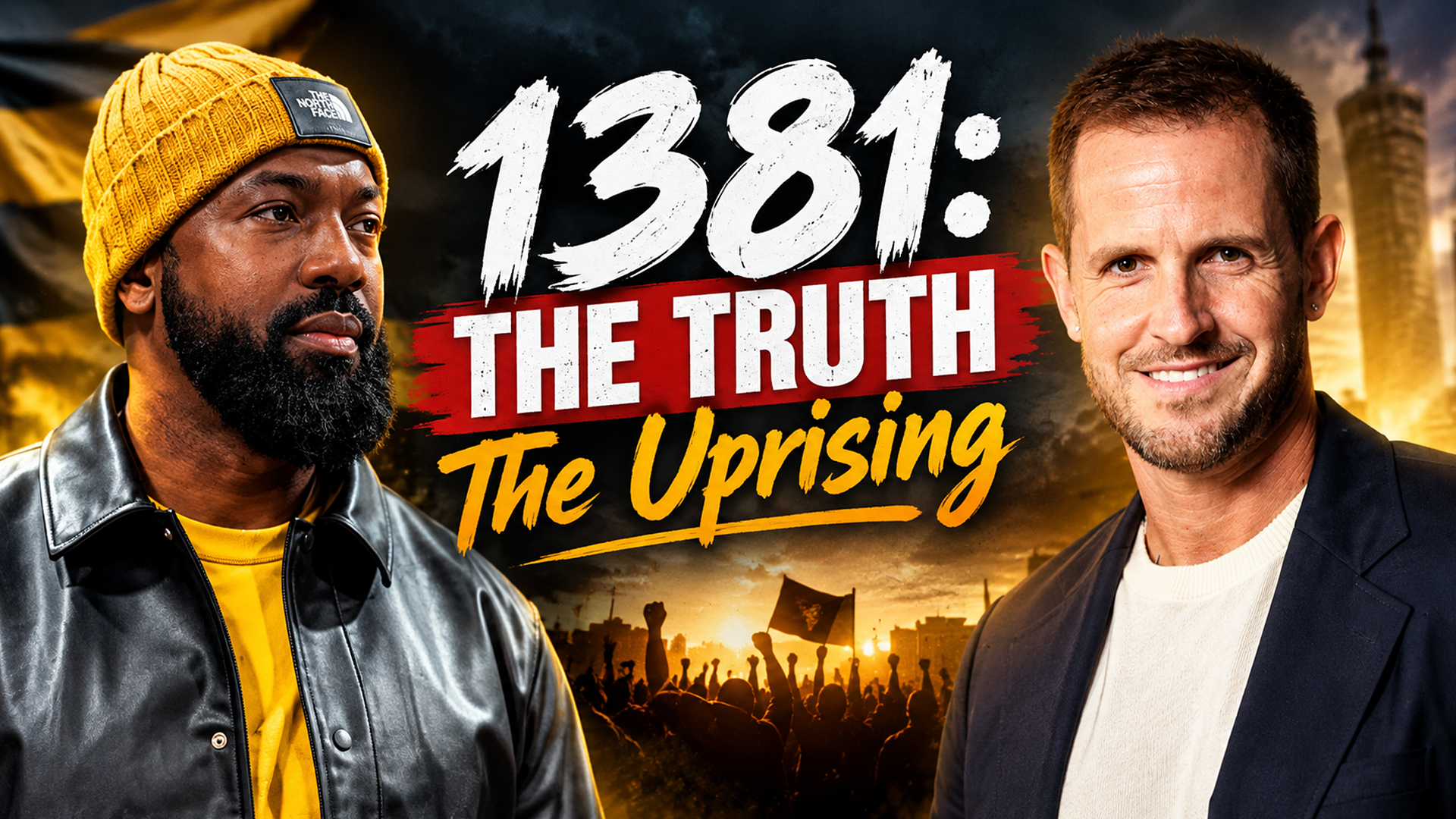
In 1381, England was half empty from the plague. The crown wanted a third tax in four years. So the farmers and craftsmen of Kent and Essex marched on London.
Paul Greengrass has made that rebellion into THE UPRISING, which is in theaters nationwide now. Andrew Garfield stars as the Ploughman. Jamie Bell plays John Ball, the priest whose sermons gave the revolt its voice.
Historian Dan Jones consulted on the film. He wrote Summer of Blood, a full book on the Peasants’ Revolt, back in 2009. I sat down with him for ten minutes to talk about getting the history right, the coffee cup question, and the preacher that Robin Hood overshadowed.
Watch the full interview
This interview has been lightly edited for clarity.
GMB: You published Summer of Blood back in 2009. What was it like sitting in the theater watching something you’ve lived with for 17 years built out at this scale?
Dan Jones: Oh, man. That’s a great question. I spent so long working on this period, and then suddenly I got to see London in the 1380s burst into this riot of color. Literal riots. It’s an amazing experience. Historians very rarely get this. We spend all our time surrounded by dusty documents and partial fragments and little drawings of the past. Then a great filmmaker like Greengrass comes along and, boom, you’ve got the world alive in front of you. It’s a joy.
GMB: For those of us on the other side, what’s the actual job of a historian on a set like this? Where do you say “go ahead,” and where do you put your foot down?
Dan Jones: Well, I’d never put my foot down and say no. You’re there to offer advice. You’re a historical consultant, and you’re there to be a resource.
I remember the first day I went to see Paul. He’d written the script. He already had a map of medieval London and London’s wall, and he’d read absolutely everything in the academic literature. He was immersed in the history and building this world out of the real history.
A little while after that, he and Andrew Garfield and I had lunch. Andrew was already alive with “okay, tell me everything I need to know about ploughing.” We were nerding out on the details already.
When a production has that kind of passion, you don’t need to worry about saying yes or no. I just say, “Here’s what the facts are, as far as I know. Here’s what this world looked like and how it worked. You guys know how to make movies. Take the information and go make a great picture that has people on the edge of their seats for two hours.”
The Uprising is a historical epic. If you’re sitting there thinking, “I wonder if the boots were really that color,” then it’s failed in its purpose. It’s a movie, and it should serve an audience that wants to forget the world for a moment and just enjoy themselves. And I think it does.
“If you’re sitting there thinking, ‘I wonder if the boots were really that color,’ then it’s failed in its purpose.”
GMB: Here’s a fun one. Game of Thrones had the infamous coffee cup left in a shot, and it became bigger than the episode itself. On a film like this, how paranoid do you have to be?
Dan Jones: Oh man, that’s way above my pay grade. And I’m glad that it is. I’m thinking about the history of this amazing rebellion and how these brilliant people are going to create characters. They’re professional, brilliant moviemakers, so I trust they’re putting their coffee cups in the trash. Everyone should do the job that’s their own. I’m glad mine is just thinking about the past.
GMB: What’s one thing people usually get wrong about the Peasants’ Revolt that this movie sets straight?
Dan Jones: I love that question. We tend to think about “the peasants” as a group. This is an age when we don’t have diaries from individual peasants, so it’s really hard to imagine them as three-dimensional, real, living, breathing, quirky individuals.
That’s what I love about The Uprising. I saw it again a few nights ago and I’m so struck by it. Every character in here is a human being. John Ball, Wat Tyler, the Ploughman, Alice, Richard, the Countess. They’re all people. The Ploughman may be called Ploughman, but he’s not an archetype. He’s a real person.
It breaks open the idea that every peasant was a nameless drone. What we actually have is a riot, literally a riot, of real individuals. They all had competing, clashing, overlapping reasons for being involved. It’s real life.
“Every character in here is a human being.”
GMB: John Ball was a priest. His line was “When Adam delved and Eve span, who was then the gentleman?” That’s scripture turned into a demand for equality. Why does history hand the credit to Robin Hood and not the preacher who lit the match?
Dan Jones: John Ball comes out with this radical Christian cry at a time when the established church and the bishops have wealth, land and estates. And he asks, where is all this in scripture? Where is the Christ of Luke’s gospel, the friend of the poor, the baby who was visited by humble shepherds? Where is he in all of this?
John Ball gives righteous anger to that cry for a return to the scriptural basis of truth. Martin Luther will do the same thing much later, in his own different way.
Then there’s Robin Hood. I’m not talking about Robin of Locksley, the Victorian romantic figure. I mean the brutal yeoman of the original 14th and 15th century stories. He comes out of the same tradition, but he’s a fictional character.
John Ball is a historical figure, so what he did and said is, in a sense, fixed. Robin Hood and the other outlaws, like Gamelyn and Adam Bell, are malleable. Each generation can retell and adapt the Robin Hood stories like comic books. They roll with the times. He can even show up as a fox.
But they come from the same place. The same world, the same age, the same concerns, the same fears, the same dreams. Robin just got the credit until now. John Ball’s on the big screen now.
“Where is the Christ of Luke’s gospel, the friend of the poor? Where is he in all of this?”
GMB: I didn’t know the story going in. You did. And man, I really had hope for Richard. I really did. But none.
Dan Jones: I’m afraid this slice of Richard’s life is part of the making of a tyrant. This is where it all starts going wrong for him. It’s a good lesson in why you should never tell a kid they’re the Messiah.
My take
THE UPRISING drops you straight into 1381. You’ll be rooting for the peasants. It shows you what life was like for a ploughman who lost almost everything and had to fight for what little he had left.
I won’t spoil what happens with Richard II. Just stay buckled in until the very end.
THE UPRISING is in theaters nationwide now. It opens in the UK on October 9.
Written and directed by Paul Greengrass. Starring Andrew Garfield, Jamie Bell, Stephen Dillane, Tom Hollander, Cosmo Jarvis, Thomasin McKenzie, Jonny Lee Miller, Woody Norman and Katherine Waterston. Focus Features. Rated R. 128 minutes.